
When to Say No to Networking Opportunities (And How to Choose the Right Ones Instead)
Networking is often treated like a numbers game.
Go to more events.
Meet more people.
Say yes to more opportunities.
And early on, that approach works.
But over time, many business owners start to notice something frustrating:
They’re busy… but not growing.
They’re attending events, having conversations, and staying visible… yet the results don’t match the effort.
No consistent referrals.
No clear pipeline.
No measurable return.
At that point, the issue isn’t effort.
It’s strategy.
Why Saying Yes to Everything Eventually Backfires
In Arkansas, relationships matter.
There’s a strong culture of showing up, supporting others, and staying connected. That’s part of what makes the business community here valuable.
But it also creates pressure.
You feel like you should attend.
You should support.
You should show up.
So you do.
And before long, your calendar is full of networking opportunities that feel productive…
…but aren’t actually moving your business forward.
Because networking isn’t about being everywhere.
It’s about being in the right places.

The Hidden Cost of the Wrong Rooms
Not all networking opportunities are created equal.
Some rooms are filled with:
- Ideal clients
- Strong referral partners
- People who actively connect others
Other rooms are filled with good people…
…but limited opportunity.
And here’s the problem:
Both feel the same in the moment.
You have good conversations.
You meet interesting people.
You leave feeling like it was worth your time.
But if those conversations don’t turn into:
- Follow-ups
- Introductions
- Referrals
- Business opportunities
Then the long-term value is minimal.
And more importantly…
Those rooms come with a cost.
Time.
Energy.
Missed opportunities elsewhere.
Because every yes is replacing something else.
When It’s Time to Start Saying No
There’s a natural evolution in networking.
Early on, saying yes helps you:
- Build confidence
- Practice how you communicate
- Expand your network
But eventually, continuing to say yes to everything creates diminishing returns.
If you’re consistently:
- Busy with events
- Engaged in conversations
- Visible in your market
…but not seeing real growth—
It’s time to shift.
Networking becomes less about exposure…
and more about intentional placement.
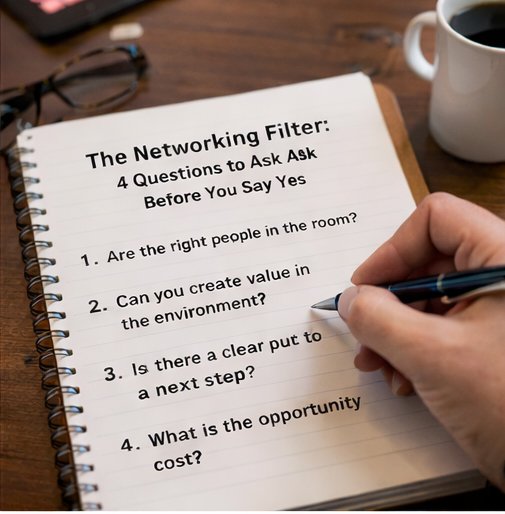
A Practical Framework for Deciding When to Say No
Instead of relying on obligation, use a filter.
1. Are the right people in the room?
This goes beyond whether people are friendly.
You’re looking for alignment.
Are your ideal clients there?
Are your referral partners there?
Are there people who can connect you to meaningful opportunities?
And if they’re not…
Is someone in that room actively working to connect you to them?
Because the best rooms don’t just gather people.
They facilitate the right connections.
If that’s not happening, it’s probably not the right room.
2. Can you create value in that environment?
Effective networking is built on contribution.
The strongest opportunities come from rooms where you can:
- Make introductions
- Share relevant resources
- Move conversations forward
If the environment doesn’t allow for that…
Your ability to generate results is limited.
3. Is there a clear path to a next step?
A good networking interaction should lead somewhere.
That could be:
- A follow-up meeting
- A referral conversation
- An introduction
If there’s no natural next step…
The impact usually stops at the event.
4. What is the opportunity cost?
This is the most overlooked factor.
Every time you say yes, you’re choosing not to do something else.
That could be:
- Serving current clients
- Building deeper relationships
- Focusing on revenue-generating work
If you don’t evaluate the trade-off…
You’re not making a strategic decision.
You’re just filling your calendar.
The Difference Between Activity and Results
One of the biggest misconceptions about networking is that activity equals progress.
It doesn’t.
You can attend multiple events every week…
…and still see little to no growth.
Real progress comes from:
- The quality of relationships
- The relevance of connections
- Consistent follow-through
Not the number of events.
What Effective Networking Actually Looks Like
When networking is working, it feels different.
You’re not just meeting people.
You’re building relationships with purpose.
You’re in environments where:
- People actively connect others
- Conversations have direction
- Introductions and referrals happen naturally
That’s where networking starts producing real results.

The Bottom Line
If you’re networking consistently but not seeing results…
The answer isn’t to do more.
It’s to be more selective.
Evaluate where your time is going.
Prioritize alignment over availability.
Choose based on impact, not obligation.
Because the right room can change your business.
But you won’t find it if you keep saying yes to the wrong ones.
Rethinking Your Networking Strategy
If you’re starting to question whether the rooms you’re in are actually working…
That’s a good thing.
It means you’re paying attention.
At Network Arkansas, the focus is simple:
Intentional rooms. Real outcomes.
Not more meetings.
Not more noise.
Just better connections that actually move business forward.
👉 Learn more: https://networkarkansas.com
👉 Apply to visit: https://networkarkansas.com/visit-a-meeting/
👉 Schedule a conversation: https://calendar.networkarkansas.com/learn-about-nia–virtual